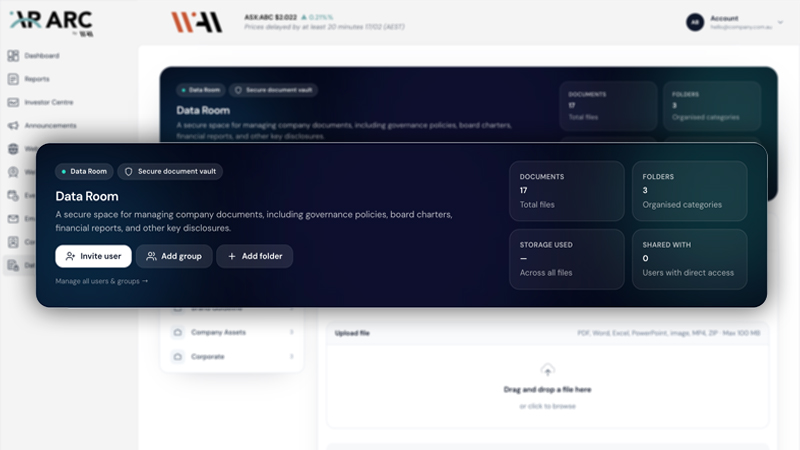
Whenever a listed company shares something confidential with people outside its walls — a capital raising, an acquisition, a due-diligence process — it faces the same tension: move fast, but keep control. The secure data room exists to resolve that tension. In capital markets it has quietly become core infrastructure.
This guide explains what a secure data room actually is, where ASX-listed companies use them, and which features separate a genuine data room from a folder with a password.
What is a secure data room?
A secure data room — sometimes called a virtual data room, or VDR — is a controlled environment for sharing sensitive documents with named parties, where every action is governed and logged. The distinction that matters is control plus accountability: not just who can open a file, but what they can do with it, for how long, and a complete record of what happened.
Generic file-sharing tools were built for convenience. Data rooms are built for situations where a leak, an over-shared link, or a missing audit trail carries real legal and market consequences.
Where ASX-listed companies use data rooms
Capital raisings
During a placement, rights issue, or IPO process, companies share detailed financials and management materials with brokers, institutional investors, and advisers — under tight timelines and confidentiality obligations. A data room lets you grant precise access, withdraw it the moment a party drops out, and see exactly who engaged with what.
Mergers, acquisitions, and divestments
M&A is the classic data room use case. Multiple bidders need access to overlapping but not identical document sets, often staged across rounds. Engagement analytics inside the room also become a negotiating signal — you can see which bidders are doing the work.
Due diligence
Whether you are being acquired, raising debt, or onboarding a major partner, due diligence means handing over your most sensitive material to people you may not have a long relationship with. Expiring access and watermarking matter most here.
Board, committee, and disclosure preparation
Sensitive board papers, draft announcements, and continuous-disclosure materials need to be shared with directors and advisers before release. Page-level controls and access logs keep market-sensitive information contained right up to the point of disclosure. This sits naturally alongside the rest of an integrated IR platform.
The features that actually matter
Most platforms claim to be "secure". These are the capabilities that make the claim real:
- Granular permissions. Control access per user and per document — view, download, or print — not just per folder.
- Expiring and revocable links. Access that ends on a date, or can be withdrawn instantly when a party leaves the process.
- Dynamic watermarking. Stamping each view with the viewer's identity discourages leaks and makes them traceable.
- Complete audit trails. A tamper-evident record of who opened what, when, and for how long.
- Engagement analytics. Beyond security, knowing which sections a party focused on is genuine commercial intelligence.
- Encryption in transit and at rest. TLS 1.2+ and AES-256 should be table stakes, not a premium tier.
ARC's secure data room with engagement analytics is built around exactly these capabilities.
Compliance and governance
For ASX-listed companies, a data room is also a governance instrument. Audit trails and access logs provide the evidence base for continuous-disclosure decisions, security reviews, and post-transaction scrutiny. If a question arises later about who had access to market-sensitive information and when, the answer should be a report, not a reconstruction from email.
Choosing a data room: a short checklist
- Can you set permissions per document, not just per folder?
- Can access be time-limited and revoked instantly?
- Is every view, download, and print logged in an exportable audit trail?
- Can you see engagement — not just access — by party?
- Does it integrate with the rest of your IR and communications stack, or is it another silo?
The last point is the one teams regret overlooking. A data room bolted on as a standalone tool creates yet another login and another data island. A data room that lives inside your IR platform means the same stakeholder you track in your engagement analytics is the one whose document activity you can see — one view of the relationship, not five.
See ARC in action
Engagement analytics, secure data rooms, and AI co-pilots in one investor relations platform built for ASX-listed and pre-listing companies.
Book a demo